On my trip throughout Central America in 1995, I saved Honduras for last. It turned out to be an incredible way to finish a four-month journey. I had already heard plenty of stories about the diving in the Bay Islands and how inexpensive everything was, but even those stories did not prepare me for Utila and Roatán.
I was getting close to the end of the trip, and money was becoming a real issue. I knew I needed to get home and back to work. But just about every time I thought I was ready to leave Honduras, I found another reason to stay a little longer.
Jump to a Chapter
Saving Honduras for Last
By the time I reached Honduras, I had already been traveling for almost three and a half months. I had moved through much of Central America, stayed in inexpensive rooms, traveled by bus and boat, met people from all over the world, and stretched my money about as far as I could.
I had deliberately saved Honduras for the end because I had heard so many good things about the Bay Islands. People kept talking about the diving, the clear water, the reefs, and how cheap it was compared with almost anywhere else.
That made Utila an easy choice. I wanted to dive, and I wanted to finish the trip somewhere that felt completely different from home.
Diving on Utila
I spent a couple of weeks on Utila and did more than twenty dives there. At the time, a full day of diving cost only $25. That included two dives of about an hour each, all the equipment, the boat, drinks, wetsuits, and everything else we needed.
I also took an Advanced Open Water certification course. The total cost was $125, including instruction, five dives, four nights of lodging, unlimited sodas, and the other course expenses. Even in 1995, that seemed almost unbelievably cheap.
I did most of my diving through Cross Creek Dive Center, although there were many competing shops on the island and most of them charged about the same prices. It was the kind of place where travelers talked constantly about which shop they liked, who the best instructors were, and which sites had been especially good that week.
The diving was great, but the atmosphere around it was just as important. Everybody was there for the same reason. We talked about dives at breakfast, went out on the boats, compared what we had seen afterward, and then met more people in the evening.
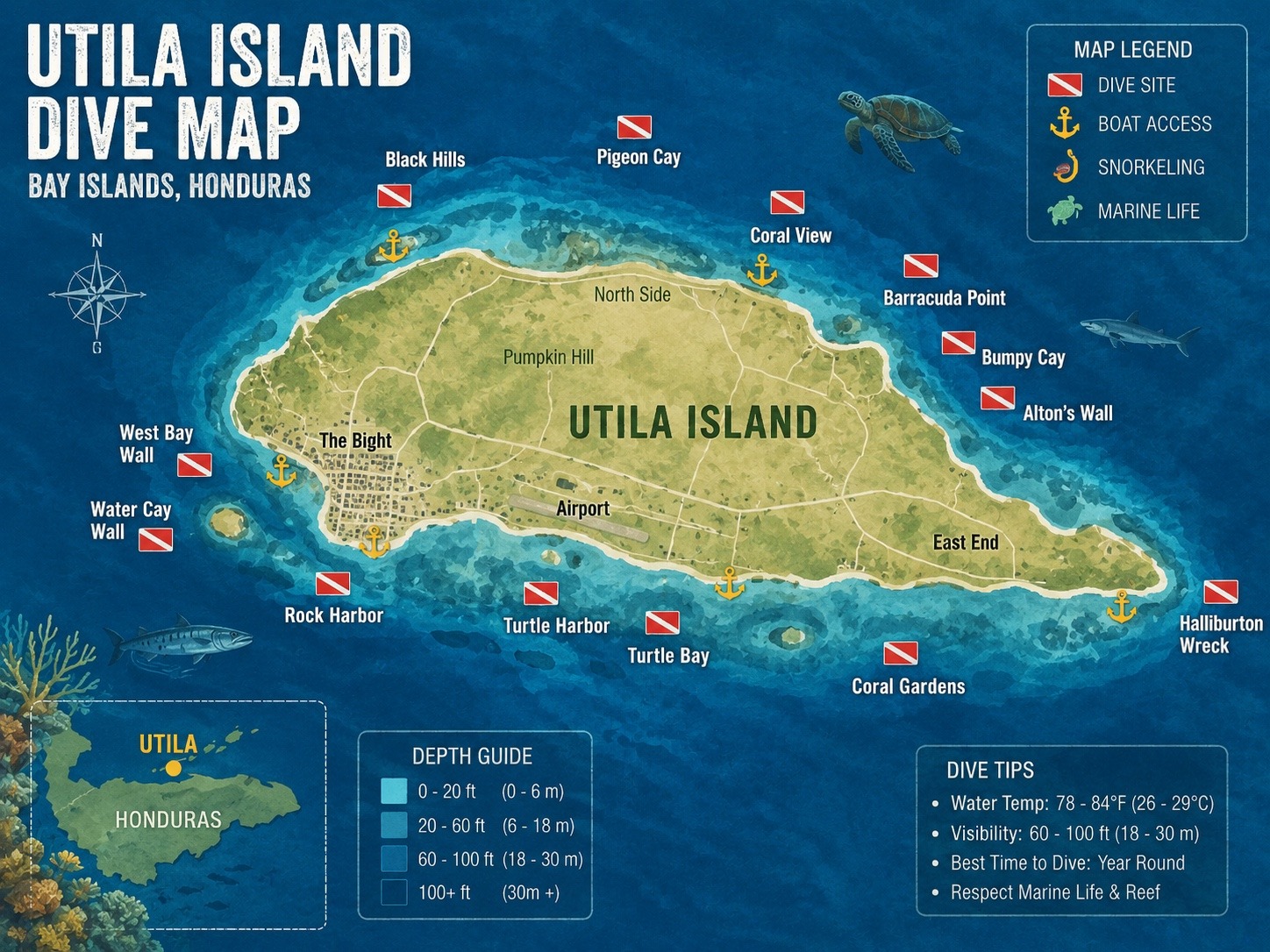
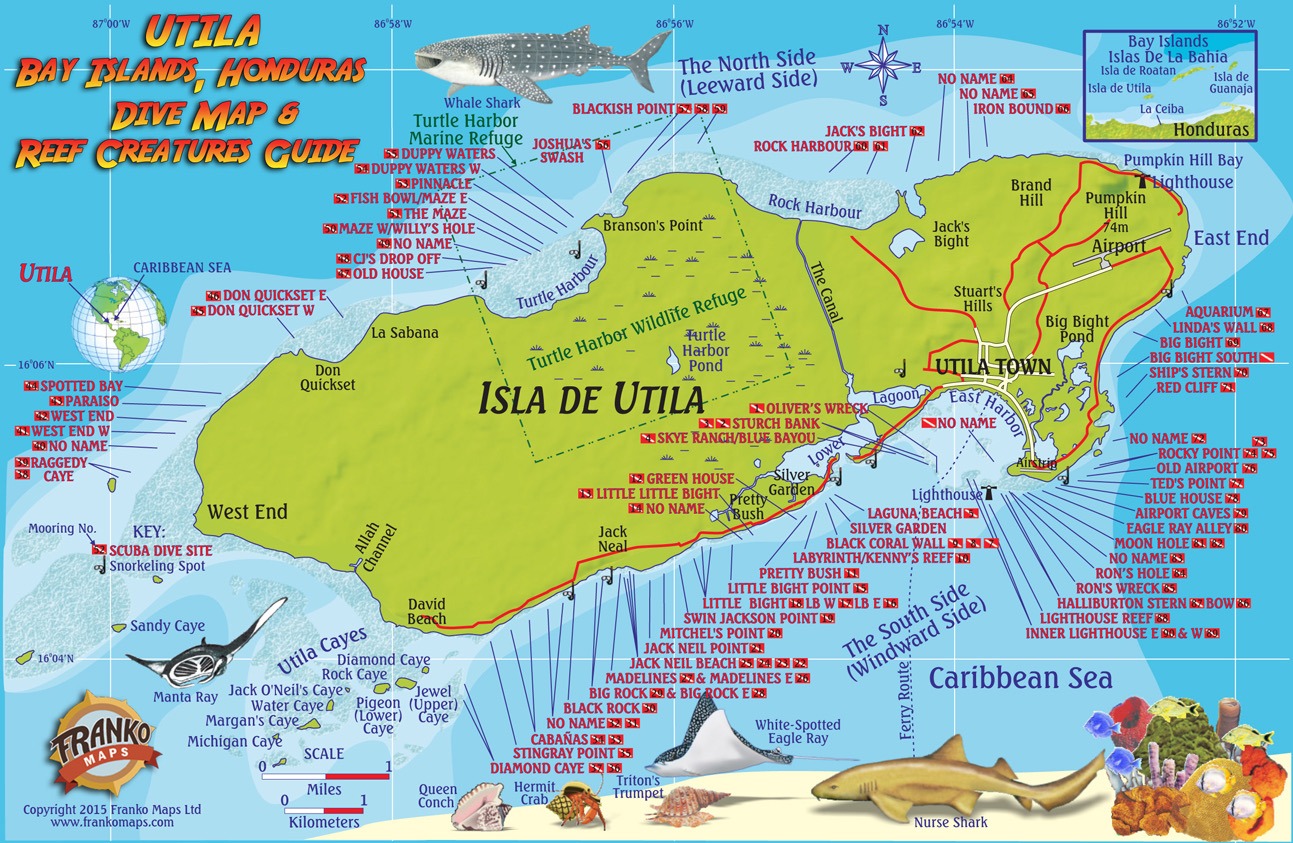
Utila Dive Maps
These two maps show many of the dive sites surrounding Utila. They help illustrate how much diving was available around one relatively small island, with sites along both the north and south shores.
One or Two Days on Roatán
After more than twenty dives on Utila, I was running out of money and needed to get home and back to work. But before leaving, I wanted to hop over to Roatán for a day or two.
Everybody said Roatán was much more expensive, which worried me because I was already low on cash. I found an American Airlines flight home for $195. I could leave from either Utila or Roatán, and the flight from Utila to Roatán cost only $17.
So I flew over, expecting to stay for maybe two days.
Eight days later, I was still there.

Jimmy's Backpackers
I stayed all eight nights at Jimmy's Backpackers, a large community bunkhouse right on the water. It cost only $2.50 a night.
It was not a fancy place, but it was exactly the kind of place I liked. Travelers shared space, talked, exchanged information, and made plans together. I met some of the coolest people there. A few of them I kept in touch with, and others I have always wished I had gotten contact information from.
Every morning, I walked along the water to a breakfast place set in a tropical garden. I usually had fruit, yogurt, and granola, or buckwheat pancakes, for a dollar and change. I sat with different travelers almost every day.
That was one of the things I loved most about inexpensive hostels and backpacker places. You did not disappear into a private hotel room. You met people because you were all sharing the same spaces and trying to figure out the same things.
My Last Dive on Roatán
The last scuba dive I did on Roatán was one of the most awesome times I had ever spent in the water, and the dive cost only $10.
I joined three other people I had met at breakfast. We went through caves, tunnels, and all kinds of really interesting underwater passages. We saw huge groupers, jewfish, and more fish than I could keep track of.
What made it especially good was that it was not just another scheduled dive with strangers. I had already met the other divers over breakfast. By the time we entered the water, we were doing it together as friends.
I had spent weeks diving in the Bay Islands, and this final dive felt like the perfect ending to that part of the trip.
West End Beach
The best part of Roatán was the beach at West End. At the time, I thought it was the most beautiful beach I had ever seen, and I had already seen hundreds of beaches along much of the coastline of North and Central America.
We could walk there along a trail beside the water in about thirty-five minutes, or take a water taxi for about a dollar. The beach had beautiful white sand, coconut palms everywhere, and a reef only about fifty meters offshore.
We snorkeled for three or four hours almost every day. The reef was close enough that it was easy to swim out, spend as much time as we wanted in the water, and then come back to the beach.
The beach faced west, so every evening ended with another sunset over the water. That became part of the rhythm of Roatán: breakfast with travelers, time in the water, snorkeling or diving, and then watching the sun go down.
The Cousteau Boat Offshore
For several days, a Cousteau boat connected with Jacques Cousteau's son was anchored offshore.
We would snorkel out toward it and dive down to where the scuba divers were below us. I remember going down around fifty feet, tapping their tanks, looking at their depth gauges, and then heading back toward the surface.
At the time, it all seemed like part of the daily adventure. We were in the water for hours, the reef was right there, and something interesting always seemed to be happening offshore.
Those were the kinds of days that made it so difficult to leave. I had a flight home waiting, but every morning still felt as though there was one more thing worth doing.
Mainland Honduras
I spent only about a week on the Honduran mainland and very little time inland, so I never got to know the interior as well as I would have liked.
Tela was cool. I remember lots of Rastafarians, good music, and a completely different feeling from the islands.
Most of my strongest Honduras memories are from the Bay Islands because that is where I spent the most time. But the short mainland visit also reminded me how much more there was to the country than diving and beaches.
I would still like to return and spend more time inland, see more of the mountains and forests, and better understand the communities away from the coast.
Why Honduras Was the Right Place to Finish
Honduras was the final country of a journey that had already lasted much longer than I expected. By then, I was tired, nearly out of money, and knew I needed to get home.
But I was also completely comfortable traveling. I had learned how to meet people, find inexpensive lodging, ask questions, change plans, and let a place tell me how long I should stay.
Utila gave me weeks of diving that I could actually afford. Roatán gave me Jimmy's Backpackers, breakfasts with a changing group of travelers, an incredible last dive, hours of snorkeling, and sunsets at West End.
The Bay Islands also brought together two things that have always mattered to me: the natural world and the people I meet while exploring it. The reef was the setting, but the friendships, shared meals, dive partners, and daily conversations were what made the experience last.
Even after almost four months on the road, I was not ready for the adventure to end. Honduras made that ending as good as it could have been.
All Honduras Images
Every image currently used on this page is shown below. Tap or click the image to open the full-size original.
Related Pages
Return to the Central America page, visit Belize, or browse the site map.