Belize · Guatemala · Costa Rica · Panama · Nicaragua · Honduras
Central America
Four months of backpacking through islands, rainforests, volcanoes, villages, reefs and friendships that changed the way I understood the world.
A One-Month Plan That Became Four Months
When I left for Belize in 1995, I expected to be gone for about a month. Instead, the journey expanded into four months of backpacking through six countries, moving mostly by local buses, ferries, small boats and on foot, and staying in inexpensive guesthouses, pensions, hostels and family homes.
I had already traveled widely in the United States and Canada, but Central America was different. It required much more flexibility, more trust, more willingness to ask questions and more comfort with not knowing exactly what would happen next. There were no smartphones, no GPS, no instant reservations and no easy way to stay in touch. Plans changed because of people I met, because of what I heard at a hostel or bus station, or simply because something sounded interesting.
That uncertainty became one of the trip’s greatest gifts. I learned that traveling independently did not mean traveling alone. In fact, it often made meeting people easier. Shared rooms, local buses, classes, dive boats, hikes and inexpensive places to stay created natural opportunities for conversation. A person could arrive in a new country knowing no one and, by dinner, be making plans with several people from different parts of the world.
I also began to understand something that later became one of my central beliefs about travel and life: whatever I was interested in doing or seeing, there were other people who shared those same interests. If I wanted to hike, there were hikers. If I wanted to explore wildlife, there were naturalists and biologists. If I wanted to dive, there were divers. If I wanted to understand another culture, there were travelers and local people willing to talk. Friendships formed around common interests, and shared interests turned unfamiliar places into communities.
Central America was the journey that transformed travel from something I enjoyed into one of the main ways I learned about nature, people and myself.
Year1995
LengthAbout four months
CountriesBelize, Guatemala, Costa Rica, Panama, Nicaragua and Honduras
Travel styleBackpacking, local transportation, guesthouses, hostels and family stays
EcologyReefs, rainforests, volcanoes, mangroves, rivers, wildlife and tropical coasts
What tied it togetherCuriosity, flexibility, gratitude, learning and friendship
View from our deck in San Pedro on Ambergris Caye.
Belize was the first country, and in many ways it established the pattern for everything that followed. I was only there for about a week during that first visit, and most of the time was spent on Ambergris Caye and Caye Caulker, but the experience was so rich that it felt much longer.
At the small international airport in Belize City, I met two German men. We decided almost immediately to catch a short flight to Ambergris Caye. The plane was an old aircraft that flew low over the water, providing a memorable introduction to the Caribbean coast and islands.
We found a two-bedroom bungalow directly on the water. It had a sitting room, a deck, breakfast and, almost unbelievably, a twenty-four-hour open rum bar. At about fifty dollars per night split three ways, it was the most expensive lodging of my entire four-month trip, but it was still only about seventeen dollars per person. Fresh fruit juices appeared in the refrigerator each day, with rum and ice nearby. After breakfast, we would sometimes mix a drink for the walk along the beach into town.
Sunset at the tiki bar with local residents and fellow travelers.
That first night we went to an outdoor tiki bar. Two women changed into bathing suits and jumped into the pool. The German men were too shy to introduce themselves, so I began talking with the women. They were twins, Lisa and Jane, about my age, and they were staying at the same place we were.
For the next several weeks, our paths stayed connected. We spent time together on Ambergris Caye, traveled to Caye Caulker and eventually continued into Guatemala. Meeting them on my first day of a long international journey felt like pure luck, but it also showed me how quickly travel friendships could form. They were among the first of many people who would influence where I went and what I experienced.
Belize had an easygoing style captured by the phrase heard everywhere: “No shirt, no shoes, no problem.” One day I needed to cash a traveler’s check. I arrived at a bank just after noon, holding a beer, wearing no shirt or shoes and carrying no identification. The manager waved me in and essentially told me not to worry. That relaxed friendliness became one of my strongest first impressions of Central America.
Lisa and Jane, whose friendship helped shape the opening weeks of the journey.
We often ended the evening at a tiki bar close to our bungalow. The owner got to know us and invited us to stop by one morning so he could take us fishing. One day we jokingly asked whether it was time to go. He asked a regular customer to watch the bar, took us out in his boat and gave us a wonderful afternoon on the water. Lisa caught a shark that was reported to be about six feet long.
Fishing in Belize with the local bar owner.
The islands also gave me an early introduction to the great reef systems of the western Caribbean. Even before later scuba trips, the water, marine life and proximity of the reef made a powerful impression on me. Belize helped connect my interest in ecology with the undersea world, and it remained high on my list of places to revisit.
I did return several times. Years later, I spent about two weeks in Belize with Carol, including roughly five days of diving. The dives became progressively deeper and more impressive, and the reef walls were especially memorable. On another return I spent a week diving throughout Belize, including the famous Blue Hole and sites far out along the barrier reef. The first visit was the beginning of the story; later visits made Belize one of the places in Central America with which I developed the deepest connection.
Lesson Learned — A Conversation Can Redirect a LifeTalking to Lisa and Jane at that tiki bar changed the route of the trip. One simple introduction led to Caye Caulker, Guatemala City, Spanish school in Antigua and everything that followed.
Guatemala: Spanish School and Learning to Participate
Jane during the early weeks of the journey.
Lisa and Jane were based in Guatemala City, and when they headed home, I traveled with them. The trip had always been partly an educational adventure, and Guatemala offered exactly the kind of experience I wanted. Antigua was already famous as a place to study Spanish through immersion, so I enrolled in school for two weeks.
I lived with a local family and spent much of each day trying to communicate in Spanish. The arrangement gave me more than vocabulary. It required me to become comfortable being confused, making mistakes and listening carefully. Living inside a household also provided a much better sense of ordinary life than staying apart in a hotel would have.
Antigua itself was an ideal place for that stage of the journey. The city’s colonial streets, surrounding volcanoes, markets, churches, courtyards and constant mix of local residents and international students created an environment where language study did not stop when class ended. Every errand and meal became practice.
Halfway through my second week I met Gretchen, another student. By then I had enough confidence to imagine leaving the structure of the school and trying to travel with the Spanish I had learned. On Friday after class, Gretchen and I bought airline tickets and flew to Costa Rica.
Local buses became transportation, meeting places and part of the education.
That decision was typical of the trip. We did not spend weeks organizing every detail. We had an idea, found a way to do it and left. The Spanish school gave me just enough confidence to be willing to take that chance.
Guatemala also reinforced the value of choosing accommodations and activities that put people together. A family stay, school, shared meals and public transportation created repeated contact with people I never would have met in a more isolated form of travel. That became a principle I carried into later adventures: choose places and groups that make interaction likely, and the journey becomes much richer.
Field Note — Travel Before SmartphonesIn 1995, plans depended on guidebooks, paper maps, handwritten addresses, ticket offices and conversations. There was no translation app or live navigation. Sometimes the uncertainty was stressful, but it also encouraged far more interaction with other people.
Costa Rica: Cahuita, Puerto Viejo and a Lifelong Friendship
Simple pensions and guesthouses made long-term travel affordable and social.
Gretchen and I flew to San José and quickly left the city for Cahuita on Costa Rica’s Caribbean coast near Panama. We found a small but comfortable place near the water. Not long after arriving, we were walking out to dinner when a woman named Ann McKenzie asked whether she could join us.
That small moment became one of the most important of the trip. Ann was not simply a companion for one meal. She became a lifelong friend. Central America repeatedly showed me that some of the most important relationships begin with ordinary questions asked at exactly the right time.
We spent roughly a day in Cahuita and then took a local bus to Puerto Viejo. I loved the town immediately: the music, the Rastafarian influence, the Caribbean culture, the coconuts, the rum and the relaxed atmosphere. Travelers from England, the Netherlands and other countries drifted through the same places. Simon and his girlfriend were among those we met, and a temporary group began to form.
Ann and I hired a dugout-style boat to search for manatees. The outing did not unfold perfectly—Ann became seasick—and we eventually stopped at a bar for lunch. But that was part of the reality of travel. Not every memorable day is memorable because everything works. Often the problems become the story.
Crossing into Panama
About six of us continued south together. We crossed the border into Panama on foot. Most of the group intended to continue through the Canal and into South America, but I was running low on money and knew I could not simply follow everyone indefinitely. That decision eventually sent me back toward Costa Rica and one of the richest experiences of the entire journey.
Golfito and Meeting Heike
The ferry toward Golfito and the route to the Osa Peninsula.
After traveling through Panama, I returned toward Golfito. I wanted to reach Corcovado because of everything I had heard about its remoteness and biodiversity. I arrived at a nearly empty hotel. Heike, a traveler from Germany, was sitting there brushing her hair. The innkeeper introduced us, and almost immediately we began making plans to backpack together.
Heike at dinner in Golfito before the journey into Corcovado.
That introduction led to about eight days in remote Corcovado National Park. We hiked for roughly seven hours along the coast carrying our supplies. The journey into the park was not simply a walk to a destination. It was part of entering a landscape that felt increasingly removed from ordinary life.
Corcovado National Park
Hiking for hours along the coast into remote Corcovado National Park.
Corcovado became one of the ecological high points of my life. The park’s rainforest, coast, rivers and wildlife brought everything I had studied in ecology and field biology into one living system. The diversity was not an abstraction. It surrounded us in the sounds of the forest, the tracks and movements of animals, the density of vegetation and the transitions between beach, river and rainforest.
At Sirena Ranger Station, I helped with radio telemetry involving tapirs. Tapirs are large, unusual mammals that look something like a cross between a horse and a pig. Assisting with the telemetry work gave me a chance to participate rather than simply observe. It connected travel, science and wildlife in exactly the way I had hoped travel might.
Heike and Tim at Sirena Ranger Station in Corcovado National Park.
Corcovado also made the value of companionship clear. Heike and I had met by chance, but we shared an interest in backpacking, wildlife, remote places and genuine adventure. Because those interests overlapped, it felt natural to travel together. This was the same lesson appearing again: when I went where the things I loved were happening, I met people who loved them too.
Arenal: Camping Beneath an Active Volcano
Heike and Tim during the Costa Rica portion of the journey.
After Corcovado, Heike and I eventually headed north toward La Fortuna and Volcán Arenal. We camped at the base of the active volcano. At intervals, the ground shook, material exploded upward and red rock moved down the slope. In the morning, ash covered the tents.
It was one of those experiences that made the physical Earth feel alive. Geology was no longer a chapter in a textbook about processes measured over immense spans of time. The volcano was active above us while we slept.
That morning we stopped at a hot spring for a bath and soak. Hot springs became one of the recurring pleasures of my travels: a way to experience geology directly while also recovering from days of hiking, camping and carrying a pack.
Christmas Day Underground
Long-term travel included quiet days as well as major adventures.
A couple of days later, on Christmas Day, we went caving. Waterfalls ran through the cave system, and we finished soaked. It was not a conventional Christmas, but that was exactly why it became unforgettable. The trip repeatedly replaced familiar holidays and routines with experiences that could only have happened because I was far from home and willing to try something different.
Afterward, Heike headed north toward Nicaragua. I traveled west to Montezuma for the New Year festivities. At that point we assumed our time together had ended.
Montezuma and Mal País
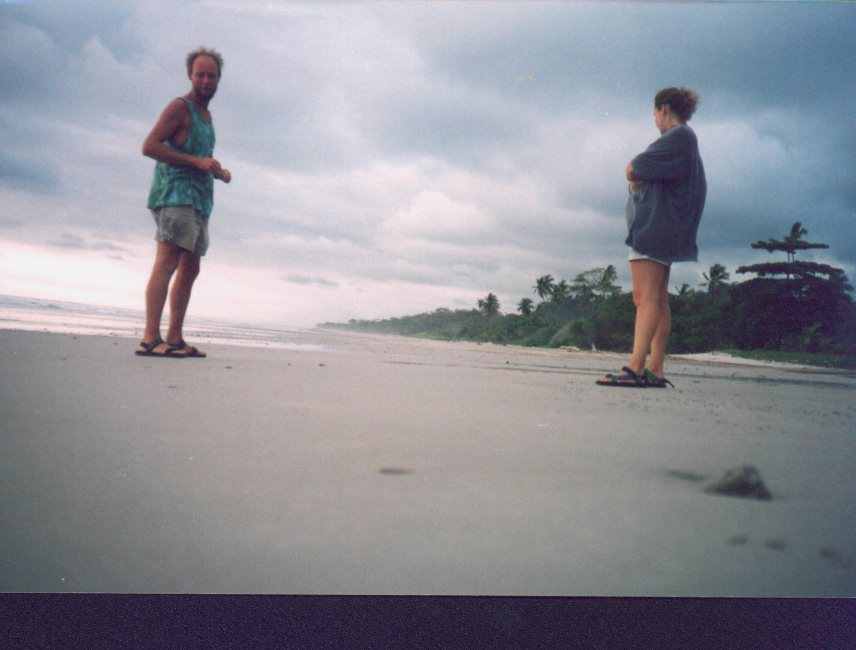
Montezuma on Costa Rica’s Pacific coast.
Montezuma had a completely different atmosphere from Corcovado or Arenal. It was a Pacific coast town where travelers gathered for beaches, waterfalls, music and New Year celebrations. The movement between rainforest wilderness, volcanic highlands and coastal communities showed how much ecological and cultural variety existed within one relatively small country.
One of the waterfalls encountered during the Costa Rica travels.
I also spent time around Mal País, where Alison appears in some of the photographs. Those Pacific coast days were part of the looser, social phase of the journey—meeting people, sharing plans, enjoying the beach and preparing to continue north.
Alison at Mal País on Costa Rica’s Pacific coast.
Costa Rica became the central chapter of the four months because it contained nearly every theme of the trip: language, friendship, Caribbean culture, wildlife, tropical ecology, backpacking, volunteer science, volcanoes, hot springs, caves, beaches and chance encounters. Even if a visitor never clicks through to the separate Costa Rica page, I want this overview to convey how full that part of the journey really was.
Lesson Learned — Travel Made Ecology RealCorcovado, Arenal, the Caribbean coast and the Pacific side transformed rainforests, volcanoes, wildlife and coastal ecosystems from academic subjects into experiences I could see, hear, feel and remember.
Panama: Bocas del Toro, Boquete and the Decision to Turn Back
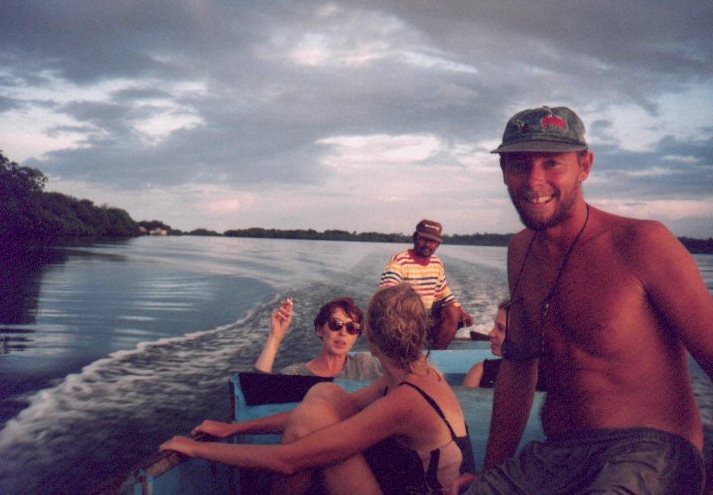
Traveling by boat during the Panama portion of the journey.
The group crossed into Panama on foot and continued toward Bocas del Toro. The islands felt wild and remote, and the week there added another Caribbean chapter to the trip. Boats, tropical water and island travel continued the pattern that had begun in Belize and Costa Rica, but each place had its own culture and mood.
After Bocas del Toro, several of us traveled west and crossed the Continental Divide toward the warmer Pacific side. Eventually, near the route toward Panama City, the group divided. Most intended to continue into South America. I was tempted, but I was running low on both money and time.
Instead, I traveled through Boquete, which was already beautiful long before it became widely known as a destination for foreign retirees. I met two men there, visited hot springs and stayed overnight. The cool mountain setting, highland vegetation and volcanic landscape provided another contrast with the low, humid coasts.
A scene from the Panama portion of the journey.
I continued through David and then began working my way back toward Costa Rica and Golfito. At the time, turning back may have felt like a practical decision forced by money. Looking back, it was one of the most fortunate decisions of the entire trip, because it led directly to Corcovado and meeting Heike.
Panama taught me that not continuing forward is not necessarily retreat. Sometimes changing direction opens the most important part of a journey.
Nicaragua: Fishing Villages, Volcanoes and an Impossible Reunion
After the New Year period in Costa Rica, I continued north into Nicaragua. San Juan Viejo was a peaceful fishing village where I spent several mellow days. It offered the kind of slower travel I had come to appreciate—time to observe ordinary life instead of rushing from attraction to attraction.
From there I headed toward Lake Nicaragua, known for its freshwater sharks and its dramatic volcanic islands. I stayed on an island formed by two volcanoes and spent about a week there.
One evening, after having a couple of beers while watching the sunset and writing in my journal, I returned to my room to shower before dinner. From the room next door, I heard a familiar laugh. It was Heike.
In 1995, without cellphones, location sharing or easy messaging, running into someone again in another country felt almost impossible. We had separated in Costa Rica and traveled independently, yet both arrived at the same place for the same reason: we wanted to climb the volcanoes.
At about four the next morning, we began the climb. The route passed through banana groves, coffee plantations, cacao farms and other cultivated zones at different elevations. The climb itself became a lesson in how climate, agriculture and vegetation changed with altitude.
We eventually reached the rim, descended into the caldera and ate lunch beside the water. By the time we returned to the hotel, we were both exhausted and hurting, but it had been exactly the kind of difficult shared experience that turns into a treasured memory.
After visiting more villages, I continued toward Managua. The city had a reputation for being dangerous, but my personal experience was more complicated than that reputation. I enjoyed being there. Travel repeatedly taught me not to reduce a place to warnings or stereotypes. Caution matters, but direct experience often reveals a fuller reality.
Lesson Learned — Shared Interests Have a Way of Reuniting PeopleHeike and I did not find one another through technology. We crossed paths again because we were both drawn to the same island and the same volcanoes.
From Nicaragua I continued north into Honduras. The Bay Islands became the final tropical chapter of the four-month journey. After months of buses, border crossings, mountains, volcanoes and backpacking, the reefs and islands provided both adventure and a kind of decompression.
The clear water, snorkeling and diving allowed me to continue exploring the underwater ecosystems that had fascinated me in Belize. Coral reefs were living landscapes, filled with structure, movement and relationships among species. Seeing them in person strengthened my interest in ecology and later helped shape the way I thought about environmental systems in my studies and work.
The islands also offered time to reflect on how much the trip had expanded. I had left expecting to be away for one month. Four months later, I had traveled through six countries, studied Spanish, lived with a family, crossed borders on foot, camped under an active volcano, explored caves, helped track tapirs, climbed a volcano, dived and snorkeled reefs and formed friendships with people from around the world.
Honduras felt like the right ending. It did not close my interest in Central America; it confirmed it.
Central America taught me that travel is one of the most powerful forms of lifelong learning. It gave me a much better understanding of how people around the world live, not through statistics or television, but through meals, buses, homes, streets, conversations and shared experiences.
It also deepened my gratitude for the extraordinary good fortune of being born in the United States and having the freedom and resources to travel. That gratitude did not make me feel superior to the people I met. It made me more aware of privilege, more interested in different ways of living and more appreciative of forms of wealth that are not measured only in money.
The natural world was equally important. Mountains, oceans, jungles, forests, underwater ecosystems, animals, plants and landscapes brought my studies in ecology and environmental science to life. Travel made classroom learning tangible and gave me memories that lasted far longer than most lectures.
Perhaps the most useful lesson was the realization that no meaningful interest belongs to only one person. Whatever fascinated me, there were communities built around it. The world was full of people who wanted to hike, dive, explore wildlife, learn languages, visit volcanoes, paddle rivers, understand cultures and seek adventure.
That is why I came to value travel arrangements that encouraged interaction. Hostels, local transportation, shared accommodations, classes, guided activities, dive boats and group hikes created the conditions for people to meet. They taught me how to get along with people who were very different from me and how to recognize the good people with whom I wanted to share my best days.
The most valuable things I brought home were not souvenirs. They were friendships, confidence, perspective, curiosity, gratitude and a lifelong commitment to keep learning.
Returning to Central America
The 1995 trip was the beginning rather than the end. I returned to Central America several times. Belize became especially important through later diving trips, including time with Carol, the Blue Hole, reef walls and sites throughout the barrier reef system.
I also returned to the region in other ways—through friendships, photographs, stories and plans. A later trip with Kym took me to Montezuma to visit my friend Callie’s retreat. Each return connected the traveler I had been in 1995 with the person I had become.
Central America remains one of the defining chapters of my life because it brought together nearly everything that mattered to me: independent travel, outdoor adventure, ecology, cultures, wildlife, learning and friendship.