From Spanish School to Costa Rica
I was attending Spanish school in Antigua, Guatemala, for two weeks when a classmate named Gretchen and I decided, halfway through the second week, that we would fly to Costa Rica when classes ended and simply see what happened.
On Friday, class finished at noon. We bought tickets, flew out that afternoon and were in Costa Rica by nightfall. We immediately jumped on a bus for the Caribbean coast and rode to Cahuita. We found a simple hostel-style hotel, dropped our backpacks in the room and headed straight back out to find something to eat.
As we were walking through the door, another traveler called out, “Hey, are you going to get something to eat? Can I join you?” Her name was Ann McKenzie. We said of course, and the three of us went to dinner together. That completely random meeting became one of the lasting gifts of the journey: Ann became a lifelong friend whom I have known for many years.
Cahuita and Puerto Viejo
After a day or so in Cahuita, we caught a local bus for the half-hour ride farther down the coast to Puerto Viejo, where we stayed several more days. The community felt old, relaxed and wonderfully unhurried. There was Garifuna music, Rastafarian culture, coconuts, rum and the easy rhythm of a Caribbean town where people seemed to have time for one another.
We met other travelers almost automatically: a couple of people from the Netherlands, someone from England, and Simon and his girlfriend among them. That was one of the qualities I came to love most about independent travel. By choosing simple accommodations, local transportation and shared activities, I constantly met people whose backgrounds and lives were completely different from my own.
Ann and I paid a small amount for a day in a homemade wooden dugout-style boat looking for manatees. Ann became terribly sick during the trip. We stopped at a bar for lunch; I had a beer or another drink, while she could manage only fruit juice. We never forgot the outing, even though the boat ride was much easier on me than it was on her.
Across the Border into Panama
A day or two later, about six of us decided to continue south together. A local bus carried us to the border, where we got out and walked roughly 200 yards across into Panama. We spent a long stretch there and had incredible experiences in its national parks.
Most of the group planned to keep traveling toward the Panama Canal and then onward to South America. I was running low on money and knew I needed to begin working my way back north, but I still wanted to see the Pacific side of Costa Rica.
I crossed Panama through the mountains and stopped in Boquete. There I met two men who wanted to visit nearby hot springs. We took a bus, soaked for much of the day and stayed in a hotel overnight. Boquete was beautiful, temperate and high in the mountains, with the kind of climate and community that later made it a popular retirement destination for expatriates.
From there I continued through David—hot, humid and sticky—and began traveling back toward Costa Rica and Corcovado National Park.
Golfito, Heike and Corcovado
Everything I had read and heard made Corcovado sound extraordinary. I expected that I might hike into the park alone and backpack for a few days. Instead, pure chance changed the plan again.
At the least expensive hotel in Golfito, the only other guest was a German traveler named Heike. She was sitting there brushing her hair when I arrived. The innkeeper told me that she also hoped to go into Corcovado, and almost immediately we decided to team up.
We gathered food and supplies, shared dinner and began what became about eight days in one of the wildest places I had ever visited. The hike into the park took roughly eight hours along the coast with a week’s worth of gear. When heavy rain moved in before we reached the ranger station, we camped beside the beach, built a fire, swam and listened to monkeys moving through the trees near our tent.
The next morning, sharks appeared to be feeding on a dead sea turtle just offshore. Later, a ranger warned us not to wade beyond our knees because sharks commonly cruised close to the beach. Even the lagoons demanded caution because caimans were often nearby.
At Sirena, I also helped with fieldwork involving radio telemetry of tapirs. That experience made the ecology I had studied in school feel immediate and alive. Corcovado was not merely scenery; it was a functioning tropical ecosystem filled with relationships among forests, rivers, beaches, wildlife and people.
La Fortuna, Arenal and Christmas Day Caving
Heike and I later traveled to La Fortuna near Arenal. The volcano was still extremely active. About every forty-five minutes the ground shook, lava shot into the sky and red molten rock tumbled down the slope. By morning, ash covered our tents.
We visited hot springs and hiked toward the waterfall near Fortuna. I biked much of the approach. Halfway up, an older man was selling coconuts, so I bought a couple to drink on the way up and a couple more for the ride back down.
On Christmas Day, we explored a cave system with waterfalls inside. We emerged soaked to the bone and delighted by the experience. It was exactly the kind of day that made this entire trip feel like an educational extravaganza—geology, ecology, culture and friendship brought to life through direct experience.
Montezuma and Mal País
I also spent time on Costa Rica’s Pacific side, including Montezuma, where a private room at Pensión Lucy cost less than five U.S. dollars a night and sat right beside the ocean.
After about a week there, I heard so many good things about Cabo Blanco and Mal País that I decided to go. Alison and I found two other women to share the cost of a truck. The route was rough and included a serious river crossing, but all five of us reached Mal País safely. The other two travelers stayed only one night; Alison and I remained for three excellent days along kilometers of nearly deserted beach.
Costa Rica became much more than a collection of destinations. It showed me how quickly strangers could become companions, how local buses could open an entire country, and how travel could transform lessons about ecology and culture into experiences I would remember for the rest of my life.
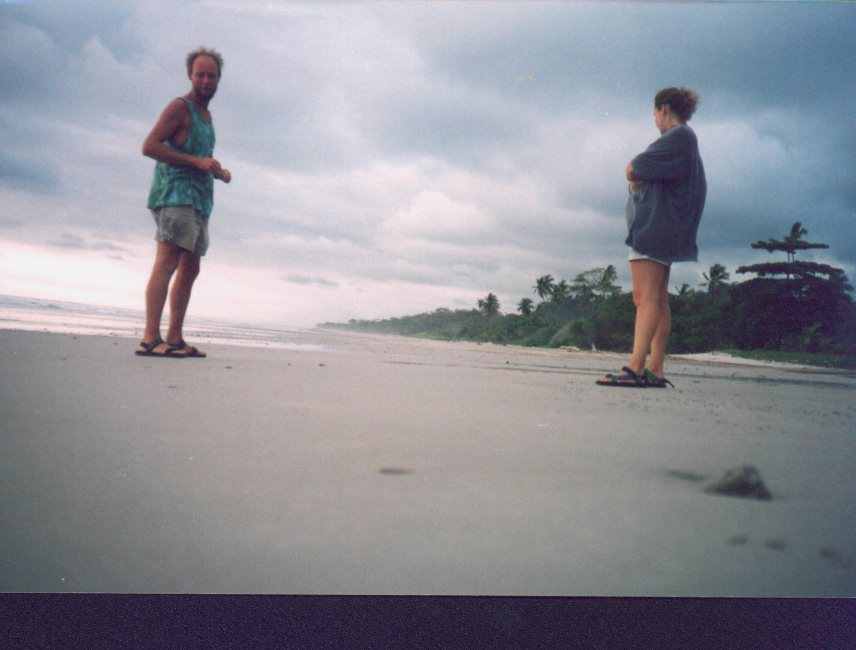
Complete Costa Rica Photo Gallery
Every photograph is displayed as large as the layout allows. Tap or click any image to open its full-size file.