One of the Finest Trips I Ever Took
In September 1991, I spent about thirty days backpacking most of Vermont's Long Trail. The trail follows the spine of the Green Mountains from Massachusetts toward Canada, climbing over one summit after another. It remains one of the finest backpacking trips of my life.
By then, hiking had already become central to who I was. I had climbed throughout New England, spent long days in the White Mountains and Adirondacks, and learned that the best way to understand a place was to move through it slowly. The Long Trail gave me an entire month to live that way—waking with the weather, carrying only what I needed, and measuring each day by ridges, shelters, water sources, and fading daylight.
Unlike a modern trail designed with gentle grades and long switchbacks, much of the Long Trail simply heads straight up. The footing can be roots, rocks, mud, wet ledges, and steep gullies. It is classic old New England hiking: beautiful, rough, direct, and honest.
Sunrise, Sunset, and the Freedom of a Bivy
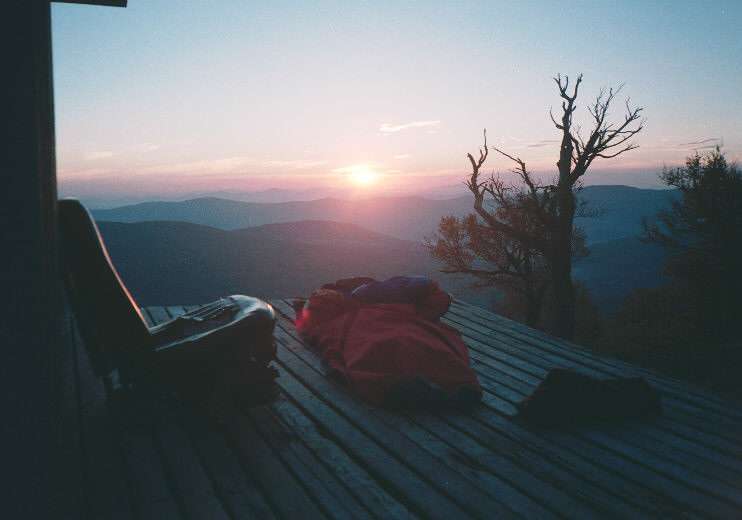
One of my favorite camps was near Mount Ellen at Mad River Glen. I rolled out my bivy sack on the porch of an old ski-hut platform and watched both sunset and sunrise from the same place. There are few luxuries better than waking up already surrounded by mountain light.
I never believed in carrying more shelter than I needed. If the forecast was decent and the insects were gone, a bivy sack or lean-to was often enough. That approach was simple, light, and completely in keeping with the kind of trip I wanted.
Why carry a whole house on your back when the mountain itself is the room?
Shelters Became Small Communities
The Long Trail's shelters and cabins were usually spaced a few hours apart. They could be rough, drafty, damp, or crowded, but they were also gathering places. At the end of a long day, strangers would share dinner, stories, trail information, weather reports, and sometimes a few drinks.
Some of the cabins were extraordinary places, especially in winter when a wood stove could turn a cold mountain night into something almost luxurious. Unfortunately, abuse and irresponsible partying eventually led to some stoves being removed. Those places only survive when the people using them take responsibility for protecting them.
That sense of shared responsibility was one of the best parts of long-distance hiking. Everyone was tired, everyone was carrying their own problems, and most people were still willing to help.

Ridgeline Weather Always Has the Final Say
One day on Mount Ellen, I tried to set up a self-portrait while the wind was howling across the summit. The gusts knocked me backward before I could get the picture I wanted. It was funny afterward, but it was also a perfect example of how quickly conditions can become serious above treeline.
Years of winter hiking and mountaineering had taught me never to underestimate wind, cold, rain, or fatigue. On the Long Trail, the weather could turn a pleasant day into a soaking, slippery grind in minutes. Good judgment mattered more than speed.
Those lessons stayed with me later in the White Mountains, the Rockies, the Bugaboos, the Andes, and every other mountain range I explored.

The Best Part Was Often the People
A lean-to might have a leaking roof, a breeze blowing through the open front, and a floor hard enough to make every bone complain. But it could still become the best place in the world when the right group of hikers arrived at the end of the day.
Long trails create temporary communities. You might walk with someone for a few hours, share one evening in a shelter, or keep crossing paths for a week. People traded food, advice, jokes, medical tape, and encouragement. Then everyone moved on.
That mix of solitude and companionship was one of the reasons I loved long-distance backpacking so much.

The Biggest Lesson: Go Light
It was always easy to tell new backpackers from experienced ones. Beginners often carried the heaviest packs. Seasoned hikers usually carried less because they had learned which items mattered and which ones merely added weight.
When an overnight pack is around twenty pounds, hiking feels completely different. You can move more naturally, climb more efficiently, and reduce the punishment to your knees, ankles, tendons, and ligaments. Heavy packs eventually sent me to doctors and rehabilitation more than once. Lightening the load changed everything.
I weighed individual pieces of equipment and questioned every item. A simple closed-cell foam pad could do the job without the weight and expense of a bulky inflatable mattress. Reused soda bottles carried water just as effectively as expensive systems. The goal was never to own the fanciest gear. The goal was to move safely and comfortably through the mountains.
I also came to love the steepest and roughest trails. Profanity Trail on Mount Mansfield was exactly the kind of direct, punishing climb that appealed to me. Drink plenty, eat often, settle into a rhythm, and keep going.
If you want to keep hiking for years, protect your body, question every ounce, and go light.
Photo Gallery
The complete Long Trail photo collection is shown again below in a large, single-column gallery. Click any photograph to open the original full-size image.