The Beginning

I began rock climbing in 1988 after spending three months traveling out west in my old hippie van. I spent much of that trip backpacking through the national parks, and everywhere I went I saw rock climbers doing something I had dreamed about for years. By the time I got home, I knew exactly what I wanted to do.
The first thing I did was sign up for the Appalachian Mountain Club's introductory rock and ice climbing course.
It turned out to be one of the best decisions I ever made. I met some incredibly interesting people, learned skills that would stay with me for life, and discovered an activity that I absolutely loved.
Yosemite: Where It All Began

When I think back on all of my climbing adventures, Yosemite National Park was where it all began.
I was out West for three months in 1987, backpacking through the national parks, and I spent four or five days in Yosemite. One thing I remember very clearly—and I still have some excellent photos of it—was standing in the meadows below El Capitan, watching the big-wall climbers who were spending multiple days working their way up the cliffs.
I remember standing behind several small groups of people who had binoculars and were watching their friends, or climbers they knew, high up on the wall. There were probably three or four different parties on El Capitan, each with three or four climbers, all in different places on that enormous cliff.
I was there at dawn, looking through their binoculars whenever someone offered me a turn. You could see climbers waking up on the wall, still half inside their sleeping bags on tiny ledges, drinking from plastic bottles, yawning, stretching, and getting ready for another day of climbing.
To me, it looked like the greatest adventure imaginable.
At that point I had no real climbing experience at all, but something about seeing those climbers living on the side of El Capitan stayed with me. It seemed so adventurous, so free, and so far beyond anything I had ever done.

One night I camped at Sunnyside Campground, better known as Camp 4, the legendary walk-in campground where generations of Yosemite climbers spent endless amounts of time bouldering, practicing their moves, and learning to climb some of the hardest routes in the world.
I actually got busted by the rangers there for sleeping in my van.
My plan had been to get up around four o'clock in the morning and hike Half Dome, which required an alpine start if I wanted to complete it in a day. But around two in the morning, the rangers knocked on my van, dragged me out, wrote me a ticket, and kicked me out of the campground.
Even with that little interruption, Yosemite had already done its job.
Seeing the climbers on El Capitan, spending time around Camp 4, and feeling the energy of that place sparked something in me. When I got home from that trip, I started checking climbing books out of the library and reading everything I could find about ropes, knots, gear, big walls, and alpine routes.
Climbing quickly became one of my obsessions.
I wanted to learn how to move safely on rock, how to trust a rope, how to climb big walls, and how to have the kinds of adventures I had watched from the meadows of Yosemite.
Learning the Basics
What impressed me most about the program was that it started with the absolute basics. Before we were ever allowed to rely on expensive climbing gear, we learned how to climb using nothing more than a rope. We learned body belays, body rappels, and how two climbers could safely protect each other using only the rope connecting them. If you ever found yourself stranded after losing your equipment, these techniques could literally save your life.
I honestly think everyone who spends time in the outdoors could benefit from taking a course like that. Beyond the climbing skills, it teaches you how to think calmly, solve problems, and trust your training when things don't go according to plan.
The course lasted about eight weekends, with each session building on the previous one. Every weekend we added another piece of equipment, another technique, and another layer of safety. Before the second class, we were expected to know every climbing knot by memory. The instructors encouraged us to practice tying them with our eyes closed, behind our backs, and even while standing in a cold shower—anything that simulated the conditions you might actually face on a mountain.
That lesson has stayed with me ever since. In climbing, there isn't much room for mistakes. You have to be able to perform critical tasks correctly the first time, often under stress, in bad weather, with cold hands, or when you're exhausted.
I do a lot of kayaking today, and one of the things I notice is that many people head into situations with little or no formal training. Some have never practiced a self-rescue, don't understand the basics of rescue techniques, or don't recognize conditions that can quickly become dangerous.
Bucket Drop Weekend
Suggested caption: Training weekends taught confidence, judgment, and humility.
About halfway through the course came what everyone looked forward to—and dreaded—the Bucket Drop Weekend.
The exercise was designed to simulate catching a leader fall. You stood at the base of the cliff, belaying while wearing a blindfold so you had no idea when the “fall” would happen. An instructor at the top slowly fed rope through your belay, simulating a climber moving up the rock. Then, without warning, another instructor would throw a five-gallon bucket filled with concrete off the cliff.
Your job was to catch the fall safely. If you did everything correctly, the bucket came to a smooth stop. If you didn't, it could come crashing down toward you. It was a pretty intimidating exercise, and several people struggled with it at first, but eventually everyone who stayed with the course learned to do it correctly.
Many of those climbing weekends were cold and rainy. Looking back, I'm actually glad they were. We learned how to climb in the kinds of conditions that often develop unexpectedly. Like so many outdoor adventures, you can start the day under blue skies and end up in cold rain with the wind picking up. If you're halfway up a cliff, you don't always have the luxury of simply heading home.
One of my favorite parts of every climbing weekend came after we packed up the ropes. We'd all head to Darcy's Pub, a small Irish pub near the cliffs, where the students and instructors would spend the evening together over burgers and a few beers. Those evenings were almost as valuable as the climbing itself. We'd hear stories from climbers who had climbed throughout New England and around the world, get honest critiques of our strengths and weaknesses, and learn about incredible climbing destinations that many of us had never even heard of.
The weekend after graduation came something called New Seconds Weekend. In climbing, the “second” is the climber who follows the leader up the route, cleaning the protection along the way. The event was held in the Shawangunks of New York, one of the premier climbing areas in the Northeast, and it remains one of the most enjoyable climbing weekends I've ever experienced.
The final event on the schedule was the annual Memorial Day trip to Acadia National Park. Climbers from throughout the club camped together at Blackwoods Campground, spending the long weekend climbing the spectacular sea cliffs and granite walls of Acadia.
Those first three months of climbing completely changed my life. They gave me a new group of friends, a lifetime of skills, and opened the door to adventures that I never could have imagined when I first drove home from my trip out West.
Climbing All Over New England
Once the course was over, we suddenly had a whole new group of climbing friends. Before long, we were climbing all over New England whenever we could. We spent weekends in the White Mountains, Rumney, western Massachusetts, Connecticut's traprock cliffs, and just about anywhere there was good rock.
At the time, my work schedule was flexible enough that I could take days off during the week, so I spent a lot of time climbing at Crow Hill, pushing my skills and building confidence. I also made many trips to Connecticut, where the steep traprock cliffs offered some outstanding classic climbs that had been established by many of New England's early climbing pioneers.
Eventually my friend Ricky took up climbing too, and the two of us spent countless weekends climbing throughout New England, especially in the White Mountains.
Out West in the Old Van


In 1992, only a couple of years after we had started climbing, Ricky suggested we spend an entire summer climbing and hiking out West. He bought an old van, we fixed it up, and headed west for what became one of the greatest adventures of my life. For nearly three months we climbed and hiked our way across the Canadian Rockies and the western United States.
We spent weeks climbing at City of Rocks in Idaho. We learned sport climbing on the crystalline knobs of the Needles in South Dakota. We climbed in the Bugaboos of British Columbia and eventually made our way to the Tetons, one of the most spectacular mountain ranges either of us had ever seen.

One of our favorite places was the Climbers' Ranch in the Tetons, where climbers from all over the world gathered each evening to swap stories and plan the next day's adventures. We spent several days camping high in the mountains after receiving permits for the South, Middle, and Grand Tetons.

We successfully climbed both the South and Middle Tetons, two long, demanding, and incredibly rewarding days in the mountains. Our attempt on the Grand Teton, however, never happened, but luckily we lived to tell why!
The night before our scheduled climb, we were camped high on a rocky bench when violent thunderstorms rolled in around four o'clock in the morning. Lightning flashed all around us while heavy rain and hail pounded our little campsite. There was nowhere to run and nowhere to hide. We simply hunkered down and hoped for the best.
By late morning the storm had finally moved on, but none of the climbing parties attempted the Grand that day. The mountain was simply too wet and dangerous. Instead, we decided to explore. That unexpected change of plans turned into one of the highlights of the trip.
After reaching the summit of Middle Teton, we decided not to descend by the standard route. Instead, we chose an incredibly steep gully on the west side of the mountain. One of the caretakers had told us it probably only saw about one descent each year because of how loose, exposed, and unpleasant it was. Naturally, that sounded like exactly the route we should take.
By the time we finally reached the bottom, we had unofficially named it the Driskell-Johnson Death Gully. At one point, Rick took off his pack and tried to lower it down a cliff, but it broke free, and rolled to an almost-stop at the edge of another cliff lower down. But is slowly kemt going, and eventually reached terminal velocity, hit a giant boulder, and exploded all over the place! We laughed so hard! We ended up sleeping in our bivy sacks on rock ledges that night..... and had an awesome night to finish off an incredible four days!

We didn't see another person for nearly twenty-four hours. It was one of those unforgettable adventures that could easily fill an entire story all by itself.
The Bugaboos: Granite, Glaciers, and Hot Springs
Suggested caption: The Bugaboos were one of the great alpine climbing stops on our 1992 western trip.
One of my favorite climbing adventures from our 1992 trip with Ricky took place in the Bugaboos of British Columbia.
Just getting there was part of the adventure. The approach began with roughly a 90-kilometer drive up an old logging road before finally reaching the trailhead. From there we hiked a couple of hours uphill, much of it after dark, before arriving at the famous Conrad Kain Hut, where we spent the next several days.
Along the way we'd run into two Australian guys whom we'd first met at a youth hostel. They weren't climbers, but they were hiking into the Bugaboos for the scenery and happily carried an extra case of beer up to the hut for us. Needless to say, we got along just fine.
Ricky and I were there for one reason—to climb.
At the hut we met another climber named Jan, and the three of us decided to tackle one of the most famous alpine routes in North America: Bugaboo Spire.

Like so many alpine climbs, it started long before sunrise. We left the hut in darkness and spent several hours hiking across glaciers before finally reaching the base of the climb around daybreak.

The Bugaboos are unlike almost anywhere else I've climbed. Massive glaciers fill nearly every valley, while enormous granite spires shoot straight up through the ice like giant stone islands.
Bugaboo Spire was exactly the kind of climb we had come all that way to experience. The lower part of the route followed a series of ledges and cracks where we took turns leading pitches. The climbing was enjoyable, the granite was excellent, and the scenery was absolutely spectacular.
Near the top we reached the famous Gendarme, one of the most memorable sections of the climb. The footholds were tiny, the exposure was tremendous, and there was very little opportunity to place protection. If you fell there, it would be a very long ride on the rope.
Somehow I ended up leading that section. Even today it's one of the climbing leads I remember most vividly.
When we finally reached the summit, the feeling was hard to describe. We had climbed one of the classic alpine routes of North America, surrounded by glaciers and granite peaks stretching in every direction.

Suggested caption: One of those climbs where the exposure and the scenery stay with you for life.
Back at the hut that evening, we celebrated with a few well-earned beers. The following day we relaxed a bit and spent time climbing easier routes with our Australian friends before continuing our journey.
While flipping through the Conrad Kain Hut register, we noticed that two of our climbing heroes—Todd Skinner and Paul Piana—had signed in only a couple of weeks before we arrived. At the time they were among the best climbers in the world, constantly appearing on the covers of climbing magazines and establishing difficult new routes around the globe. We couldn't help wishing we'd arrived just a little earlier.
After leaving the Bugaboos, we continued through the Canadian Rockies, climbing cliffs above natural hot springs. Every evening we'd finish a day on the rock by soaking in the warm mineral pools while looking up at the mountains we'd climbed.
It reminded us of another favorite stop earlier on the trip—City of Rocks in Idaho. There we'd spend all day climbing, then drive about an hour down a dusty dirt road through open cattle country to a small hot spring operated by a Mormon family. We'd quietly sneak a few beers inside, and although the woman running the place clearly knew what we were doing, she always seemed to look the other way. Ricky and I joked about inviting her to join us for a beer, but decided it probably wasn't the best idea.
Looking back, the Bugaboos and the Canadian Rockies weren't memorable just because of the climbing. They were memorable because they perfectly captured the life we were living that summer—climbing incredible mountains by day, meeting interesting people wherever we went, sleeping in huts, hostels, and campgrounds, and ending many evenings in hot springs with good friends, already looking forward to the next day's adventure.
Ice Climbing and Finding My Community
Suggested caption: Ice climbing in the White Mountains opened another door.
Around 1991 or 1992, the Appalachian Mountain Club offered its annual ice climbing program, and I signed up. Unlike the introductory rock climbing course, this one was fairly selective. They wanted people who already had plenty of winter hiking and backcountry experience, along with the proper cold-weather equipment.
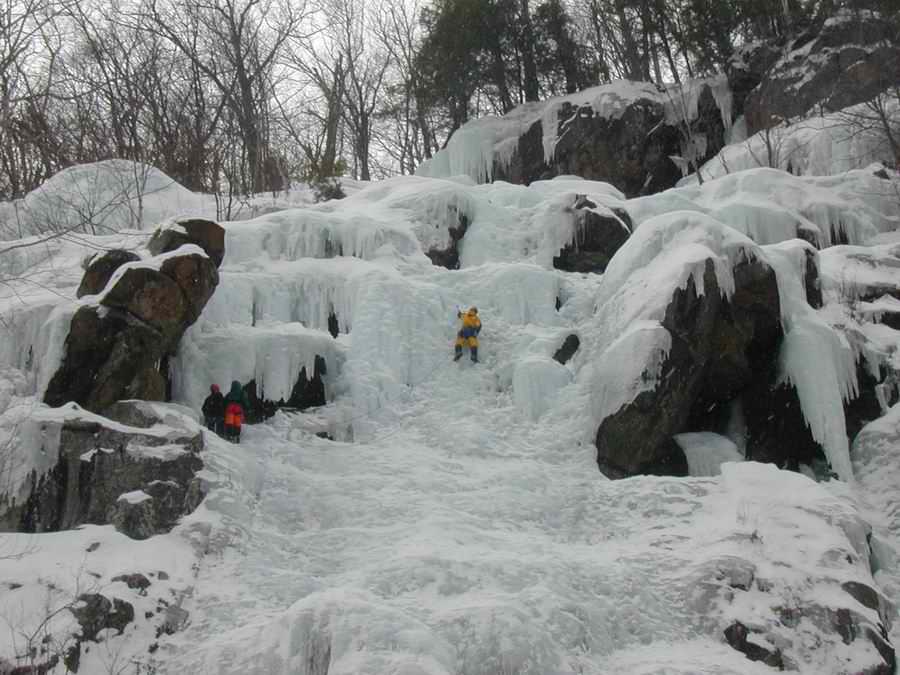
Most weekends were based out of Harvard Cabin in the White Mountains, a rustic two-story cabin that became our home for the weekends. Everyone slept upstairs on the floor in sleeping bags, while downstairs was one large room with a kitchen, tables, and a wood stove. After long days climbing frozen waterfalls, we'd spend the evenings cooking dinner, telling stories, studying guidebooks, and getting to know one another.
Looking back, one of the biggest things climbing taught me had very little to do with climbing. Up until then, I had done most of my hiking and backpacking alone. Climbing is different. Safe climbing almost always requires a trustworthy partner. That meant I had to learn not only the technical skills, but also how to meet people, judge character, and choose partners who were both enjoyable to spend time with and competent enough that I could trust them with my life.
For me, that was a major step in my own personal growth. I learned that I could comfortably show up by myself, join a group of complete strangers, and come home with new friends and future climbing partners. That lesson has stayed with me throughout my life, whether climbing, paddling, backpacking, or traveling around the world.
Instead of hiring guides every time I wanted to climb, I built a network of climbing partners, something that proved invaluable during my travels. One memorable example happened near Independence Pass outside Vail, Colorado, where I met another climber at a hostel. The next day we headed into the mountains together, climbed most of the day, then made the right decision to rappel down when thunderstorms began building overhead.
One style of climbing that always fascinated me was big-wall climbing. One summer, while Ricky and I were climbing out West, we found a newly established route that was roughly 1,600 feet tall. The technical rating looked just within our abilities, so we decided to give it a try. We spent the entire day climbing pitch after pitch, eventually reaching somewhere around eight to ten rope lengths above the valley floor. Looking down, our van beside the road had become nothing more than a tiny speck in the distance.
Climbing with Two Strangers in the Cirque of the Towers


One of the coolest climbing adventures I ever had happened in 1994 when I headed by myself into the Cirque of the Towers in Wyoming's Wind River Range.
The Cirque is one of the most famous alpine climbing destinations in North America. Towering granite spires surround an alpine basin, and nearly every peak offers a classic route. It had been on my wish list for years.

When I arrived at the Big Sandy trailhead, I noticed two German climbers loading their packs for the hike into the Cirque. They looked to be about twenty years older than I was, so I wandered over and struck up a conversation. Before long I offered to carry one of their climbing ropes into camp. They gladly accepted and then surprised me by saying, “If you're willing to carry a rope, you're welcome to climb with us.”
The three of us hiked into the Cirque together, established camp, and planned to climb two of the most famous alpine routes in the country: the East Ledges of Pingora and the East Ridge of Wolf's Head.
The first day we climbed Pingora. It was everything I had hoped for: beautiful granite, spectacular exposure, and incredible views in every direction. We finished early enough to avoid the afternoon thunderstorms that so often develop in the Wind Rivers.

The following morning we were up around four o'clock to begin the long hike over endless talus and scree to the start of Wolf's Head. Instead of climbing a single peak, you spend much of the day traversing a long, narrow granite ridge. Once you're committed to the ridge, retreat isn't easy.

For most of the day everything went perfectly. Then, about halfway across the third summit, we noticed thunderstorms beginning to build in the distance. By the time we reached the final summit, dark clouds had completely surrounded us. The air felt charged, thunder echoed through the mountains, and it was obvious that lightning was only minutes away.
We had to locate the rappel anchors, which consisted mostly of faded slings wrapped around blocks of rock, along with a few old, rusted pitons. We backed them up by leaving one of our own pieces of protection and began the long series of rappels.
I went first. Almost immediately I found myself hanging free in space, spinning slowly at the end of the rope with hundreds of feet of air beneath my boots. Above us, lightning flashed while thunder rolled across the Cirque. Hail began bouncing off the cliffs as the rain intensified. It was one of the most frightening climbing situations I've ever experienced.

Somehow, all three of us made it safely to the bottom. We found shelter beneath a rock overhang and waited out the storm for about an hour before hiking back to camp under clearing skies.
Some of my greatest adventures happened because I wasn't afraid to walk over to complete strangers and introduce myself. Those two German climbers certainly could have climbed faster by themselves. Instead, they welcomed a younger American they'd met only a few minutes earlier, shared two unforgettable climbs, and helped create memories that I've carried with me ever since.
Climbing in the Andes
Suggested caption: Climbing in the Andes was high on my list when I traveled through South America.
Over the next several years, I continued climbing throughout New England and the western United States, but I gradually became more interested in snow and alpine climbing. When I eventually traveled to South America, climbing some of the great Andean peaks was high on my list.
While I was in Peru, I hired a local guide for a four-day backpacking and climbing trip in the Cordillera Blanca. The guide, his cousin, and I crossed glaciers, climbed several summits, and reached elevations of around 16,000 feet. Much of the trip took place in the shadow of Huascarán, the highest mountain in Peru.
About a month later, while traveling through Ecuador, I decided to attempt Cotopaxi, the country's second-highest mountain and one of the world's highest active volcanoes. Since I had been backpacking for months and wasn't carrying mountaineering equipment, I hired a guide. Besides providing all the technical gear, the guide also handled the permits and logistics.
Our team consisted of the guide, two Austrian climbers, and me. After a long Jeep ride up the mountain, we hiked to the Refugio at roughly 14,000 feet, where we'd spend the night before our summit attempt.
That afternoon we headed onto the nearby glacier to practice self-arrest techniques and crevasse rescue. It was good training because much of the climb would cross heavily crevassed terrain, and everyone needed to be comfortable with the equipment before heading higher.
After dinner we sat around talking while drinking plenty of mate de coca, a tea made from coca leaves that many people in Peru and Ecuador use to help relieve the effects of altitude. We crawled into our sleeping bags around seven or eight that evening, knowing we'd be getting up again shortly after midnight.
The wind hammered the hut all night long. When midnight arrived, we stepped outside into the darkness. The weather was still rough, but after discussing it, we all agreed to at least give it a try and see how conditions developed higher on the mountain.
For hours we worked our way upward through the darkness, weaving carefully around crevasses in the glacier. Sometime around seven in the morning, daylight finally began to spread across the Andes, and we paused briefly to watch the sunrise. It was one of those magical mountain moments I'll never forget.
As we climbed higher, the altitude began catching up with the others. Both Austrian climbers were developing severe headaches, exhaustion, and difficulty breathing. We were around 17,000 feet and only a few hundred meters below the summit when they finally admitted they weren't feeling well enough to continue.
The guide asked how I felt. Honestly, I felt great. Sure, I was cold and tired, but I was enjoying every minute of it and felt strong enough to continue climbing. With a grin, I asked whether I could simply untie myself from the rope and continue alone. He smiled, made the sign of the cross over me, laughed, and said something like, “Go for it, my friend.” Of course, we were both joking.
So instead we sat down, finished our chocolate, drank the last of our hot cocoa, and began the descent together. Not long afterward, the mountain reminded us exactly why rope teams exist. As we crossed another section of glacier, I suddenly punched through a snow bridge and fell into a narrow crevasse. Fortunately it was only about a foot wide, and I instinctively caught myself with both elbows across the opening before falling any deeper. At exactly the same moment, the other climbers dropped to the snow, drove their ice axes into the glacier, and arrested the fall.
We never reached the summit of Cotopaxi, but I've never considered the trip a failure. It was another unforgettable mountain adventure filled with incredible scenery, good companions, a few tense moments, and another reminder that some of the greatest rewards in mountaineering have very little to do with standing on the highest point.
The End of One Adventure... and the Beginning of Another
Suggested caption: When one outdoor chapter ended, another one began.
My climbing career came to an abrupt end on a cold night in January 2002. A truck crossed into my lane and hit me head-on.
I woke up in the hospital with my pelvis shattered. My entire pelvic ring had been broken, and it took a twelve-hour surgery to put everything back together with plates and screws. During those first three weeks in the hospital, I knew my climbing life had probably changed forever.
When I finally spoke with my surgeon after the operation, he told me something I had already begun to suspect. He explained that climbing with my injuries would simply be too dangerous. If I ever took a significant fall, all of my body weight would be concentrated through the climbing harness directly onto the repaired bones in my pelvis. It simply wasn't a risk worth taking.
That was hard to hear. After spending nearly three months recovering in a nursing home, I had plenty of time to think about what the future might look like. The surgeon also advised me that I probably shouldn't carry heavy backpacks anymore. At that point I realized that not only were my climbing days likely over, but so were the long backpacking trips that had been such an important part of my life.
But eventually I realized something important. What I truly loved wasn't just climbing mountains or carrying a heavy pack. I simply loved being outdoors.
That realization changed everything. Instead of focusing on the activities I had lost, I began looking for new ones that my body would still allow me to enjoy. I could still hike, although more gently than before. I could still spend time in the mountains. I could even do some easy climbing in an indoor gym as long as I was careful and avoided falls.
After moving to Florida, I discovered sea kayaking. It gradually became my favorite outdoor activity of all. Part of that was simply because Florida is surrounded by beautiful water, but another reason was that kayaking was remarkably kind to my injured hip. It allowed me to spend long days exploring nature without causing additional damage to the injuries that had ended my climbing career.
Even today, I still have all of my climbing gear. Every now and then I visit the climbing gym in St. Petersburg, and I still hope that someday I'll get back onto some easy sport climbs in the Appalachian Mountains—not to push my limits, but simply to enjoy the feeling of climbing real rock again.
Looking back, I don't think of climbing as something I lost. I think of it as one incredible chapter in a lifetime of outdoor adventures. It introduced me to lifelong friends, took me to places I never dreamed I'd visit, taught me judgment, confidence, and self-reliance, and gave me memories that I'll carry with me for the rest of my life.
For me, that next adventure just happened to begin in a kayak.
Related Links
Suggested links to add later:
Home Page | Site Map | Tuckerman Ravine Adventures | South America Adventures | Kayaking Adventures